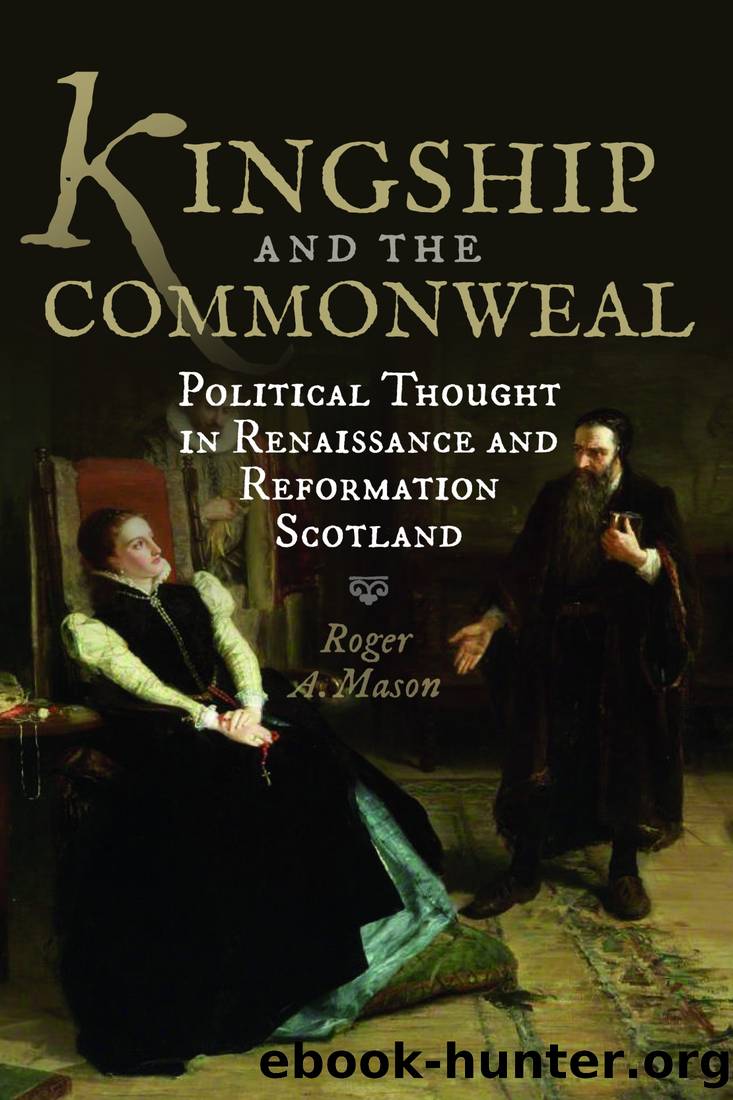
Kingship and the Commonweal: Political Thought in Renaissance and Reformation Scotland by Roger A. Mason
Author:Roger A. Mason [Mason, Roger A.]
Language: eng
Format: epub
Tags: History & Theory, Great Britain, Europe, Renaissance, Political Science, History, General
ISBN: 9781862320116
Google: lhmJAAAAMAAJ
Goodreads: 4340597
Publisher: Tuckwell Press
Published: 1998-01-15T10:31:41+00:00
CHAPTER 5
Knox on Rebellion
An expanded and annotated version of the introduction to my Knox On Rebellion (Cambridge, 1994), pp. viiiâxxiv. I am grateful to Quentin Skinner and Jane Dawson for their helpful comments on earlier drafts of this essay.
John Knox has a well-established place in the history of European political thought. His notable contribution to the development of a theory of armed rebellion against duly constituted authority features prominently in almost all modern histories of sixteenth-century political ideas.1 Despite his canonical status, however, Knox was no political thinker in the conventional sense of the term. His best known works, The First Blast of the Trumpet against the Monstrous Regiment of Women, The Appellation to the Nobility and Estates of Scotland and The Letter to the Commonalty of Scotland, all of them published at Geneva in 1558, are less systematic political treatises than religious polemics couched in the language of Old Testament prophecy. It was as a preacher and a prophet, Godâs trumpet and His messenger, that Knox confronted the critical issue of resistance to tyranny. While it has long been recognised that his views evolved gradually in the specific circumstances of the Marian exile, the violence of his biblical rhetoric has led many commentators to exaggerate the radicalism of his ideas at the expense of their complexity.2 As we shall see, however, what emerged in the key tracts of 1558 was not the indiscriminate theory of popular revolution with which he is often credited, but a much more nuanced political programme which set out a general though limited theory of aristocratic rebellion and which made a critical but largely unnoticed distinction between its application in a covenanted England and an uncovenanted Scotland.3
*
There was little in Knoxâs background to suggest that as a self-styled instrument of God he was destined to wield considerable influence over the course of the Reformation in Britain.4 Of his early life, in fact, very little is known. Even the date of his birth â c. 1514 â is conjectural, though we can say that he was born of humble parentage in the Scottish burgh of Haddington, East Lothian, and that he was probably educated at the local grammar school before attending St Andrews University. There is no record of his graduating from St Andrews, but he did take holy orders in the later 1530s and, unable to obtain a benefice, eked out a living as a notary apostolic (a minor legal official) and a tutor to the children of the Lothian gentry. The date of his conversion to Protestantism is similarly obscure, but it must have occurred in the early 1540s as Knox was closely involved with the ministry of George Wishart who returned to Scotland in 1543 after five years of exile in England and on the continent. Wishartâs return appears to have been prompted by the Protestant and Anglophile policies pursued by the Regent Arran following the death of James V in 1542 and the accession to the Scottish throne of the infant Mary Stewart.
Download
This site does not store any files on its server. We only index and link to content provided by other sites. Please contact the content providers to delete copyright contents if any and email us, we'll remove relevant links or contents immediately.
| Africa | Americas |
| Arctic & Antarctica | Asia |
| Australia & Oceania | Europe |
| Middle East | Russia |
| United States | World |
| Ancient Civilizations | Military |
| Historical Study & Educational Resources |
Room 212 by Kate Stewart(5273)
The Crown by Robert Lacey(4935)
Endurance: Shackleton's Incredible Voyage by Alfred Lansing(4921)
The Iron Duke by The Iron Duke(4466)
The Rape of Nanking by Iris Chang(4324)
Joan of Arc by Mary Gordon(4211)
Say Nothing by Patrick Radden Keefe(4123)
Killing England by Bill O'Reilly(4107)
I'll Give You the Sun by Jandy Nelson(3553)
Shadow of Night by Deborah Harkness(3474)
Hitler's Monsters by Eric Kurlander(3465)
Eleanor & Park by Rainbow Rowell(3364)
Blood and Sand by Alex Von Tunzelmann(3299)
Mary, Queen of Scots, and the Murder of Lord Darnley by Alison Weir(3293)
Darkest Hour by Anthony McCarten(3223)
Margaret Thatcher: The Autobiography by Thatcher Margaret(3169)
Book of Life by Deborah Harkness(3036)
Red Famine: Stalin's War on Ukraine by Anne Applebaum(3027)
The One Memory of Flora Banks by Emily Barr(2953)
